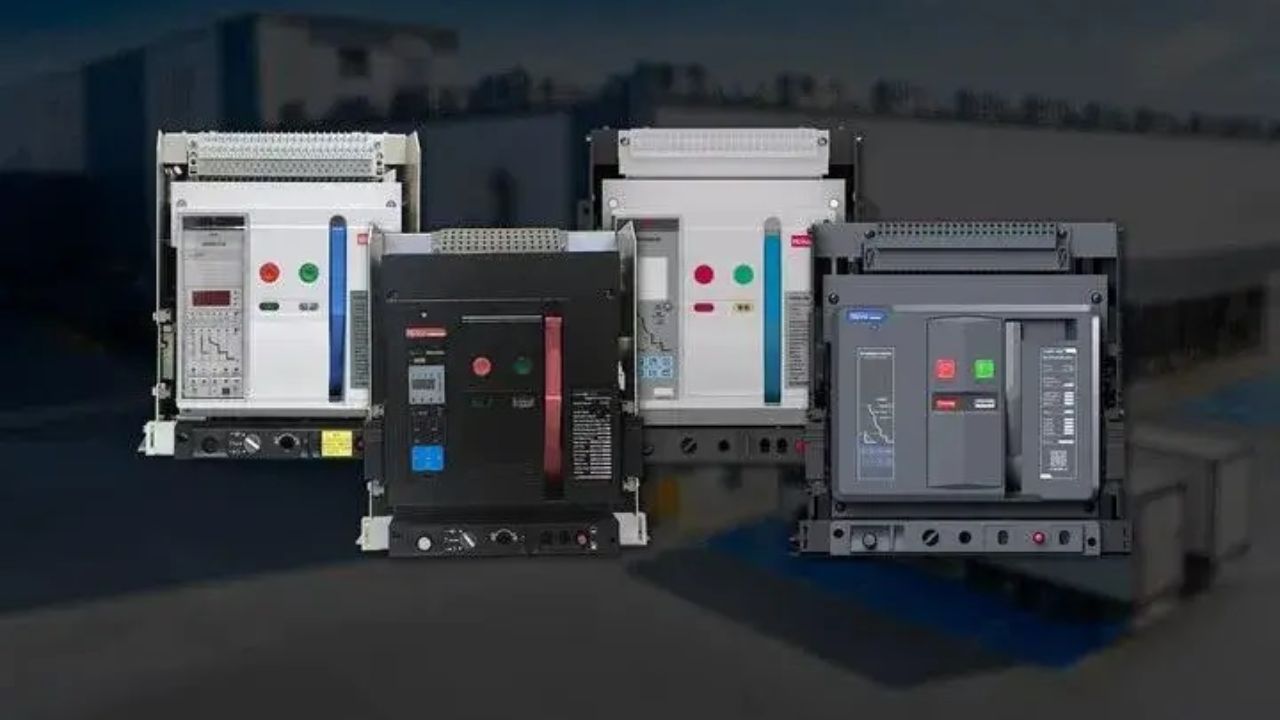
The low-voltage power distribution system is significant in the supply of dependable electricity to residential, commercial, and industrial premises. The most important thing is to make sure that there is safety, efficiency, and uninterrupted functioning in these systems. The Air Circuit Breakers (ACB) are one of the important devices that protect such networks. The capability of air circuit breakers to offer accurate protection, reliability, and versatility to many applications has made them an inevitable element in the contemporary low-voltage power distribution.
The Familiarity with Air Circuit Breakers
Air circuit breakers are electrical switching appliances that are used to safeguard electrical circuits against overloads, short circuit currents, and faults. ACBs are not generally used in systems where lower current ratings and simpler protection features are needed as compared to miniature circuit breakers (MCBs) or molded case circuit breakers (MCCBs). They work on the principle of making contacts in a closed compartment with pressurized air that is used as a medium for arc reduction in fault conditions. The arc is put out by the air efficiently, and this is aimed at avoiding the destruction of the system, as well as reducing the downtime.
The intelligent controllers are common in modern ACBs, and they can communicate with the monitoring and control systems. This functionality allows selective protection, remote monitoring, and connecting to smart energy handling networks. These characteristics are especially useful in industrial premises and in large business houses where it is essential to have a constant power supply.
ACBs are used in low-voltage distribution.
Low power distribution systems are often associated with voltages up to 1000 volts. ACBs are used in such systems as the main protective means of main switchboards, distribution boards, and critical loads. They are supposed to make sure that any abnormal condition, including an overload and short circuit, is isolated in the shortest time possible to avoid causing damage to equipment and minimize both the chance of fire and electrical risks.
The selective protection of air circuit breakers is increased by their ability to provide selective protection that is accurate, ensuring that only the contactors of a faulted part are disconnected during a fault. Such selective isolation has the effect of reducing intrusion to the rest of the network and enhancing the overall reliability of the system. Also, ACBs can help to maintain the safety of operation and decrease the risk of arc flashes and electrical accidents that may have serious implications in industrial environments.
Benefits of Air Circuit Breakers in Low Voltages
Air circuit breakers have a number of advantages that have made them a choice in low-voltage power distribution. Their breaking capacity is quite high, and as a result, they are able to deal with the large fault currents without damage. This is very important in systems that provide heavy machinery or critical infrastructure, where fault currents may be important.
The other strength is that they are durable. The ACBs are made to work continuously over a long period of time and have uniform behavior even under strenuous conditions. Modern ACBs are home-made to withstand critical environments, temperature, and mechanical stress due to the construction being designed to be strong, and the material used in the construction is of high quality.
Industrial and Commercial Facilities ACB Uses
Air circuit breakers have become very popular in many areas such as manufacturing, data centers, hospitals, and commercial complexes. ACBs are used to guard against electrical faults in the manufacturing plants, ensuring that motors, transformers, and production equipment are not damaged due to electrical faults that cause expensive downtime. They are used in data centers to have uninterrupted power availability to critical IT infrastructure, where even a short duration of power interruption can prove to be very detrimental.
ACBs have been a solution in offering a solid level of protection to the lighting systems, HVAC systems, and other important services in commercial buildings and hospitals. Facility managers can track the performance of their electrical systems, identify anomalies, and take appropriate action as soon as possible because they can unify with the building management systems. This integration increases safety, minimizes energy wastage, and sustains sustainable operations.
Conclusion
Low-voltage power distribution systems can not do without air circuit breakers. They protect important equipment and ensure continuity of operations and improved safety within the industrial and commercial premises by offering effective protection against additional loads, short circuits, and faults in service. High breaking capacity, durability, and smart control make ACBs an indispensable part of a modern electrical network. With the development of power systems and the use of smart technologies, the air circuit breakers will be at the center of providing an efficient, safe, and continuous supply of electricity.